Saturday, 25 March 2017

Friday, 24 March 2017
Task 13: Evaluation Question 3 - What have you learned from your audience feedback?
Evaluation Question 3
Audience feedback has been an asset to me throughout my production. During the early stages where I was drafting ideas, and coming up with ideas on what I could do, I decided it would be beneficial for me to carry out a survey and see what kind of things people like/ prefer the most.
I created my multiple question survey using strawpoll.me and sent each question to the either my participants.
From that data collected I came to the conclusion on which genre was more desirable and what sort of themes that people would want to see, I also was able to find out which type of music video, such as that of narrative, abstract, performance, was the most preferred.
Following this I then drafted an idea for a music video and what genre/song choice in addition to a rough overview on the narrative and then presented it as a pitch to my classmates.
After presenting my pitch and ideas and ideas I took my classmates questions at the end and also asked them for their ideas. From this I found that my initial idea was strong and was worth pursuing, but I also was warned by a few classmates as to the song choice. This was because for them they felt it was too upbeat in comparison to the themes and narrative of the music video. However other classmates felt that the song was a good choice as the lyrics fit the theme and the beat would be easy to edit with.
Ultimately it was an even split so had to take the liberty upon myself to decide whether or not to use the song for my final music video.
During production audience feedback was vital to me. This audience feedback came in the form of my partner/co-actor who was around for all stages of filming. Although with stuck to and adhered to the storyboard as close as possible there was a lot of stuff that we would have to improvise or create to fill the gap in-between our established scenes. The feedback my partner gave was through challenging and bringing forward ideas, an example of this would be debating on what camera angle to shoot a certain scene or how the acting should unfold on camera. Having this extra person and not having to be completely independent meant that I was available to receive constructive feedback and also have constructive conversations and build ideas. This, in my opinion, added to the overall quality of the music video as it meant that different ideas were explored.
However in the editing stages I had no audience feedback at all and had to complete the editing process completely independently.
Upon completion of my music video I showed it to all my classmates for post production feedback. The music video was overall positively received, however an error spotted by my classmates was a lip syncing error in one of my scenes. This error was overlooked by me so having audience feedback meant that I could amend my error and have a polished final piece. Another piece of feedback I received that one of the scene transitions I made looked really tacky, happened too fast and overall did not fit the rest of the music video. I took this feed back and went back into Sony Vegas and chose a more simplistic approach to the transition. So instead of the image squeezing from the right of the screen to the left it instead is just a flat image with fade transition at the end. This change improved the flow of the music video and gave it a more completed feel.
Thursday, 23 March 2017
Task 13: Evaluation Question 2 - How effective is the combination of your main product and ancillary texts?
Evaluation Question 2
The combination between my ancillary texts and main product has been very successful. My digipack, magazine advert and final music video show a clear and strong connection to one another.
To begin with my magazine advert and digipack strongly and clearly convey the theme and overall tone of what my main product is.
Firstly in the digipack we can clearly see what the main products narrative is going to centred around. Four out of the six pages of the digipack are that of the characters, each character having two pictures of them. By doing this you can tell or at least confidently assume that the music video will be a story about these two characters.
Furthermore each picture of the characters show a clear emotion which connotes the themes and tone of the music video, therefore making it an effective combination.
To develop this point, in one photo we see the male shirtless naked and exposed from the chest up. This is a striking piece of imagery and is added to the fact that the colour is an emotionless black and white, however the only colour in the scene is the blood dripping from his eyes almost like tears and the snake constricting around his neck. All of this imagery combines to create a flurry of negative emotions which perfectly links to my main product as it is about domestic abuse and the failure of a relationship.
The front cover of my digipack is that of the female character with the words "Tainted" running across the top and "love" along the bottom. This links to my main product as it is the title of the music video/song. Furthermore the back cover features the album song list, bar code + record company and then it has "Alex Dean's Tainted love" written vertically on each of the sides. This is an effective combination to my main product as it shows who the artist/creator of the song is.
Another clear connection to the main product through the magazine advert and digipack is also made. This was done by featuring the song name on both the magazine advert and digipack, not only this but I also included the album cover onto the magazine advert to further strengthen the connection. In addition to this I also made an effort the keep the imagery used on the digipack and magazine advert related, so on the magazine advert I chose an image of both the male and female characters looking away into the sunset. Again this is a good combination as it stays true to the theme I am trying to send, looking out into the sunset creates the feeling of uncertainty and insecurity. Lastly by featuring both characters I am again strengthening the link on what my main product is going to be about.
Using the same font on both my digipack and magazine advert also helped combine the ancillary texts with the main product, this is because it establishes a clear artistic/aesthetic link between the two, which therefore makes it easier to relate them to each other. Not only this but it also meant that my work looked more competent and professional than it otherwise would have with instead using an array of fonts that don't compliment each other.
***real reference
Wednesday, 22 March 2017
Task 13: Evaluation Question 1 - In what ways does your media product use, develop or challenge forms and conventions of real media products?
My music video both develops and challenges forms and conventions of a typical music video. Andrew Goodwin’s theory states that there are five main key components to a music video. Those key components being Genre characteristics, relationship between lyrics and visuals, relationship between music and visuals, inter textual references and the ‘emphasis of looking’.
For genre characteristics I conform to the con ventions of a typical pop music video. This is because my music video is about love and bad breakups/heart break, although I go a step further by including more serious themes the convention of love and heartbreak is still the base foundation on which my music video is built on.
This theme of love and heartbreak can be seen all over the industry, but a couple examples include the music videos “Blank space” by Taylor swift and “We found love” by Rihanna. Both of which I analysed for my research and planning. These music videos, like mine, show the extremes at both ends of a relationship, from really happy and in love to depressed/angry and violent/abusive.
Another conformity is that pop music videos like to use suggestive imagery and connotations in their music videos. Things such as using colours to display emotions such as red lipstick connoting towards lust and love and black/white connoting to depression and a lack of emotion. I utilise both of these connotations in my music video to express its themes.
In regards to the relationship between lyrics and visuals a clear link can be made between the narrative and lyrics of the music video. This can be seen in a shot where the lyrics of the music video are being translated visually through an over the shoulder shot. The lyrics are translated in the form of a text message via phone screen. This relationship, however, is quite literal in regards to the lyrics. Less obvious relationships between lyrics and visuals are also made. Such as when the lyric “Take my tears and that's not nearly all” is played, on screen this is visualised through self-harm and the flowing of blood.
Relationship between music and visuals are also made in my music video. I use music in a variety of ways in my music video. One example of this would be using the music as timing for cuts. The song tainted love has a very distinct pair of beats that are used rhythmical and periodically throughout the song which gives the song its distinct flare. The two beats are very impactful thuds, I use this impact to integrate/complement a series of Jump cuts that cut at the start of each short beat.
My music also develops the conventions of a typical music video through how it is edited. Towards the end the relation between music video and visual is expressed through how the visuals are editing. As the music video nears the end and the music starts to slow down the visuals that can be seen are scenes previously seen in the music video but now in reverse, this connotes/suggests the desire to undo what has happened and to amend the past.
My music also develops the conventions of a typical music video through how it is edited. Towards the end the relation between music video and visual is expressed through how the visuals are editing. As the music video nears the end and the music starts to slow down the visuals that can be seen are scenes previously seen in the music video but now in reverse, this connotes/suggests the desire to undo what has happened and to amend the past.
Furthermore Inter textual references are made through things such as mise en scene. Notably biblical references are made. This can visually be seen through a scene where a snake is wrapped around an apple. This references to Adam and Eve and their corruption to sin, this idea of corruption and sin fits perfectly into the message I wish to deliver in my music video as it is about the deterioration of love and relationships.
Monday, 20 March 2017
Task 12: Audience Feedback
Audience Feedback
Initial audience questionnaire feedback:
From my questionnaire results I found out what was the overall most desired genre of music video (pop) and what style of music video it would be. 44% of people wanted a narrative based music video whilst the next biggest vote (28%) wanted a performance based music video. From this I knew I wanted to include elements of both but heavily focus on the narrative, this creates it so I can satisfy two of the biggest majorities.
Presentation pitch feedback:
The feedback I received from the presentation pitch was mixed. Some people did not like the song choice where as others did, it was an even split so I could not make a definite decision on the song and had to acknowledge that song choice is a subjective preference based choice. The reasons why some disagreed with the song was due to its upbeat tone and rhythm, however the lyrics of the music video counterbalance this upbeat tempo due to their clear meanings and messages. In the end I decided to go with my original song choice.
Mid production feedback:
Mid production I did not have as much audience feedback as the other stages. The only feedback I received was when I showed my partner/actor assistant the progress I was making with the editing of the music video. Feedback was limited to a few scenes/sequences where she either liked or disliked something in the editing or clip choice. However the upwards majority of the editing process I confided to my self and trusted my own decisions and direction.
End of production feedback:
At the end of my production I shared my final product with my class for feedback. However unbeknownst to me, my class mates spotted a lip syncing error which I later went back and corrected. Furthermore I also received construction feedback on a particular transition I used in a particular scene which featured the imaged being stretched out from the right side of the screen to the left side of the screen. However what was observed is that the transition does not have enough time for it to be effective in the way how I first intended it too and instead ended up being confusing and disorientating, this all resulted in the flow of the music video being disturbed. I therefore listened to the constructive feedback on my editing choice and went back to a more simple approach. I simply had the scene a normal image with no moving effects and transitioned it out with a smooth and 'easy on the eye' fade.
Wednesday, 15 March 2017
Editing process


Translating and reversing the image. By doing this I move the image around the screen and can position it on the side I would want it to be


Frame by frame change in opacity to create smooth transition. I did this by cutting the clip up into smaller segments and adjusting the opacity so that it gradually reduced each frame as can be seen in the image above.
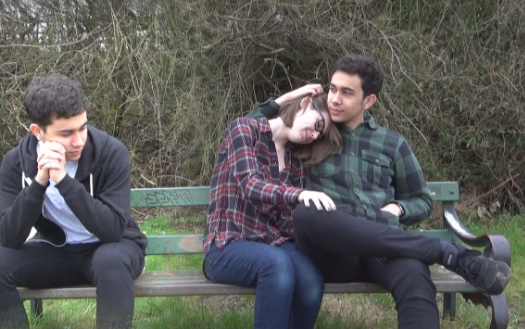
To clone myself into the same image I used the Event Pan/Crop feature, where i then edited the mask of the image using the anchor tool as seen below.
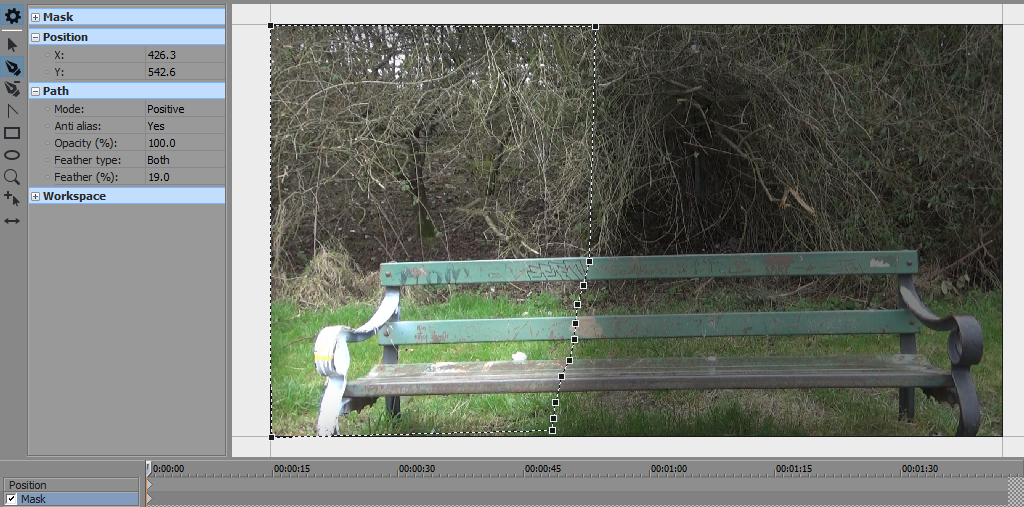
This cuts out everything that is not anchored onto the image, allowing the clip underneath to play over. However, at first when I did this a clear line/divide could be seen between the two images. To fix this I used the feather variable, as seen above, to blend the line dividing the two images. The higher percentage that the Feather variable is on the more the two videos/images will blend into each other.
However only having one static line which divides the two is problematic due to the fact that ,no matter what, one of the sides will go over the line an break the illusion.
To overcome this I used keyframes to adapt the 'masking line' frame by frame so that neither pictures would would go over the line and inturn appear to dissapear
I then had to colour correct one of the videos as the lighting was somewhat darker than the overlaying video.
For slowmotion, it was really straightforward. To slowmo my clip all I had to do was hold the CTRL key and drag the video clip back to a shorter length. However issues with this came in the form of laggy frame rate. Due to my camera not recoding and a high enough FPS slowing down the clip too much resulted in a drastic reduction in video quality.
Inversely I also dragged out clips to a longer length uthing the same method, this resulted in the video becoming fast motion, fast motion yielded a better look/quality than slowmotion
Monday, 13 March 2017
(Task 2.2) Research into print artefacts
Print artefact research
 As can be seen In this poster for drake we can see immediately that the artist (Drake) is made very clear and pushed to the viewer. In addition to this we can that in the bottom right corner on the poster the name, art and release date is shown for his new and upcoming album. The album and the poster both share a very similar aesthetic.
 Furthermore, on the poster we can also see information on advertising such as where to buy tickets for his tour and also a website url that goes to the record labels webpage.
A similar thing is also seen with Ed Sheeran. On the post for his tour his is clearly the main focus in the poster. The posters backdrop is also the artwork to his album, not only this but in the bottom left we can see again his album cover with the title "available now" underneath it. Even though both artists are from different genres of music they both use the same techniques in advertising and art to both promote the artist and advertise their new content/music effectively.

Finally we have another artist who does exactly the same thing. The artist is clearly in the foreground of the art with the album in one of the corners. The album art in all cases take up a small amount of space relative to everything else and this is due to the fact that it is not the first main focus on which the audience is intended to view.
All three of these examples show a clear correlation on how advertising and the branding of artists is done within the music industry, it is safe to say that it is very formulaic and is a clear way on how to do things
Subscribe to:
Posts (Atom)